
日本 無修正 マスタべ
ほど人気で無修正 マスタベ シーンを豊富に取り揃えたセックス動画サイトは他にありません お持ちのデバイスでが厳選した画質のエロ動画セレクションをお楽しみください
マスタベのエロ動画一覧マスタベのエロ動画を時間更新 エロビデオネットはマスタベのエロ動画を簡単検索できます 極上のエロ動画を無料で配信中 好きなカテゴリーの動画や女優を見つけてください
素人 マスタベ
素人無修正 マスタべ
オススメの無料エロ動画サイトは一択だ という三拍子揃ったなら効率的かつ確実にや素人モノで快適なオナニーライフが送れるようになる 動画本数広告の少なさ画質の良さ動画の速さありとあらゆる点においてトップレベル
最高の日本サイト永遠に無料高速ラグなし万本以上の動画毎日更新再生中に広告なし
マスタベ動画 ポルノビデオを視聴しましょう大量の エロ動画を視聴しましょうで年もののの セックス
マスタベ無修正 素人
マスタベ無修正
日本 無修正 マスタべ
ほど人気で無修正 マスタベ シーンを豊富に取り揃えたセックス動画サイトは他にありません お持ちのデバイスでが厳選した画質のエロ動画セレクションをお楽しみください
マスタベのエロ動画一覧マスタベのエロ動画を時間更新 エロビデオネットはマスタベのエロ動画を簡単検索できます 極上のエロ動画を無料で配信中 好きなカテゴリーの動画や女優を見つけてください
素人 マスタベ
素人無修正 マスタべ
オススメの無料エロ動画サイトは一択だ という三拍子揃ったなら効率的かつ確実にや素人モノで快適なオナニーライフが送れるようになる 動画本数広告の少なさ画質の良さ動画の速さありとあらゆる点においてトップレベル
日本 無修正 マスタべ
マスタベ無修正
動画を保存するにはログインが必要ですマスタベ
動画を保存するにはログインが必要ですマスタベ
動画を保存するにはログインが必要ですマスタベ
動画を保存するにはログインが必要ですマスタベ
マスタベマスタベ
前半は制服後半はエロいシースルーのコスプレです敏感すぎて感じまくりの美少女に半中半外です
動画を保存するにはログインが必要ですマスタベ
国民の人妻の名に違わぬ熟れたボディと幼さの残る顔立ちがエロくて最高だと思う青い瞳にブロンドヘアの純米国娘で豊満なアメリカンボディがエロくて最高だと思う
素人ナンパ家でマスタベばっかりやってる電マ好きなショートヘア美女とホテルエッチ優良サイト 素人海で見かけた女性に童貞くんのマスタベを手伝ってもらいましたすると
好きに楽しめばよいのじゃ素人ナンパ 宣言年にマジックミラー号便でナンパした本物素人娘 総勢人を全員収録
食べマスからたべっ子どうぶつ のどうぶつ達が初登場 らいおんくんとかばさんが 小さくてぽってりしたフォルムの 練り切りになりました 中身の餡の味はらい
並べ替え 新しい順公開日 すべて再生時間すべて分分分並び替え新しい順人気順評価順公開日すべて日週月本の動画がみつかりました
花音うららリストありちょっと大場美奈に似てて可愛いってかみなるんより可愛いわ
シコニャンセレクションだぞマスタヘトンに居ます 寂しいので来てね
中城葵リストありおしゃぶり予備校
編集りょうどうも東海オンエアですぜひチャンネル登録お願いしますサブチャンネル東海オンエアの控え室もぜひチャンネル登録してねグッズ購入はこちらから
素人美女や女優があなたの為だけにオナニーしてくれる安全安心究極のエロサイト登場 マスタベなどの無料エロ動画サイトって無料でエロ動画が見れて便利ですよねでも本来有料なはずのコンテンツが無料で見れるなんて少し怪しいななて考えたことがある人も多いのではないでしょうか 多くの無料エロ動画サイトが著作権などを無視して配信しており摘発される可能性があるもので違法であるということは頭に入れておくべきです
動画を保存するにはログインが必要ですマスタベ
餡砂糖餅粉などを使って作られた和菓子で キャラクターを再現した食べられるマスコットです 繊細で手の込んだ細工と口当たりの良い味わいを お楽しみいただけます
エログちゃんねるあんてなアダルトブログランキング幻想のエロティカ動画チャット個人撮いいね無料素人ちゃんねる無修正ランド
素人マスたべ
The economic and demographic evolution of Europe's regions determines which ones are stagnant and more likely to support populist parties.
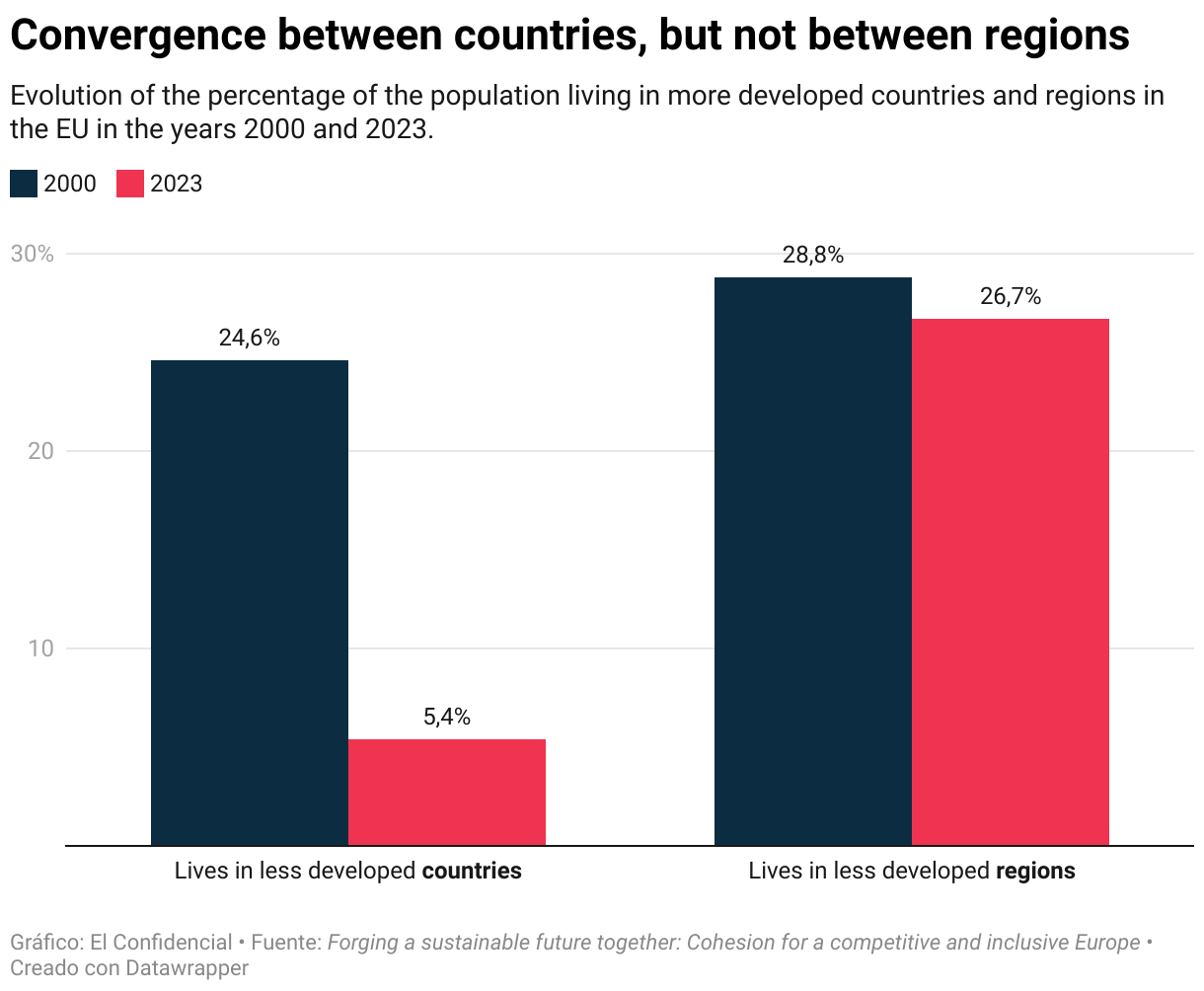
The European Union has managed to reduce inequalities between its member states thanks to cohesion policies. Countries such as Poland, coming from far behind, have achieved significant convergence with the rest of the Union in just two decades.
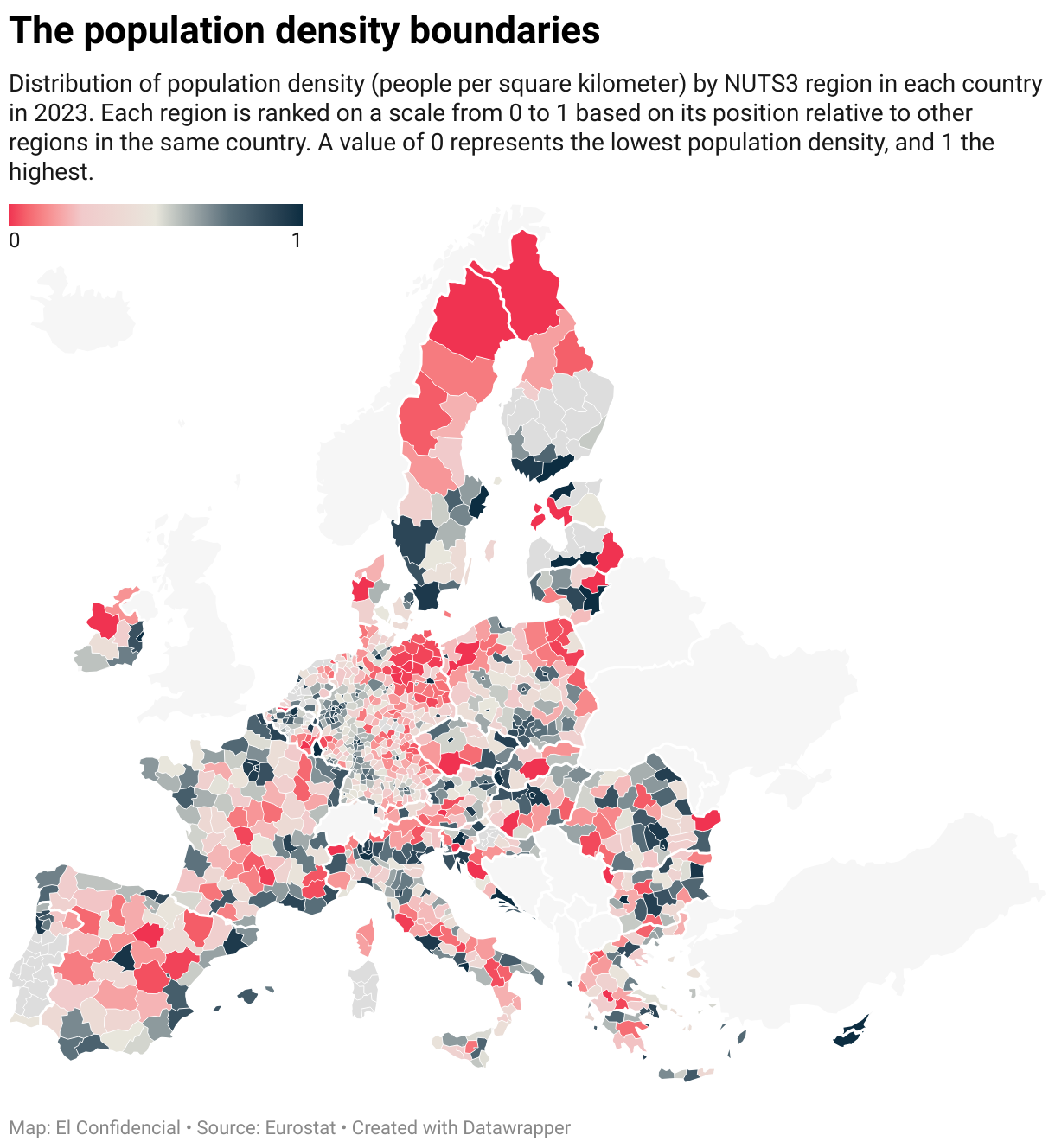
However, as these gaps between countries narrow, internal imbalances between regions are becoming more pronounced. Across Europe, economic growth is concentrated in a few urban areas, while many rural regions and medium-sized cities remain stagnant.
The European Commission defines the development trap as the moment when a region stagnates and stops advancing compared to its own past, the rest of the country, and Europe as a whole. This situation generates a feeling of abandonment among the population of these territories, who consider themselves ignored by public policies.
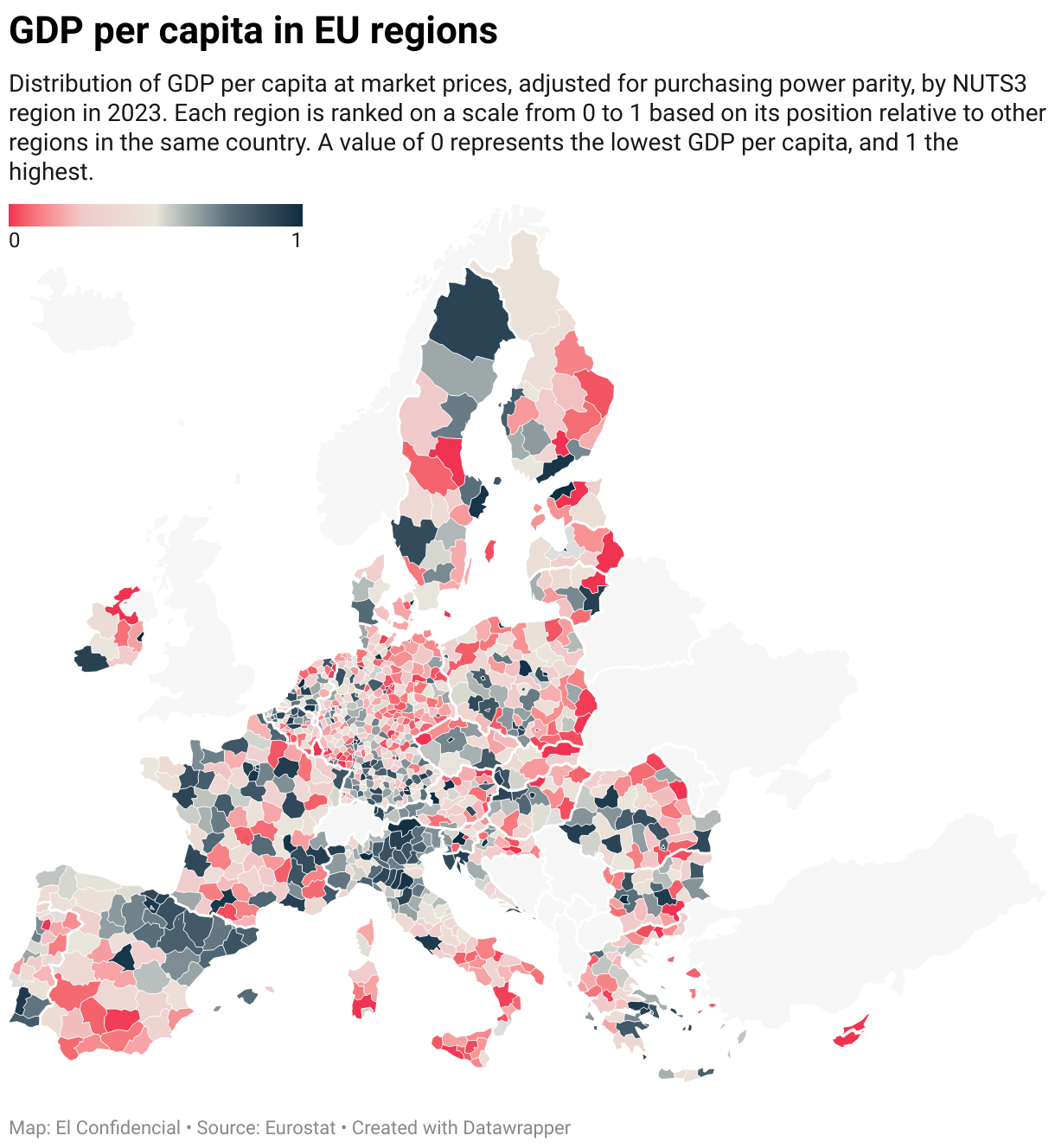
Economic theory holds that capital concentrates where there is greater potential and spreads to its surroundings. The reality in Europe shows that this is not always the case. For example, Paris absorbs resources from all over France, while cities such as Orléans barely benefit.
According to Andrés Rodríguez-Pose, professor of Economic Geography at the London School of Economics, focusing solely on large metropolises is like trying to fly a plane with a single engine: not all the potential is exploited and many territories with development capacity are forgotten.
Forgotten Europe
The pitfalls of development create a vicious circle. The longer a region remains stagnant, the further it sinks. The deterioration of basic services—education, healthcare, and transport—and the lack of job opportunities fuel social frustration, which strengthens Eurosceptic parties.
“In almost all European countries, economic activity is extremely concentrated in the most important cities, usually the capitals, widening the gap with the rest of the territory,” explains Rodríguez-Pose. This imbalance causes a brain drain to the most dynamic urban centers, while the regions of origin age and lose population.
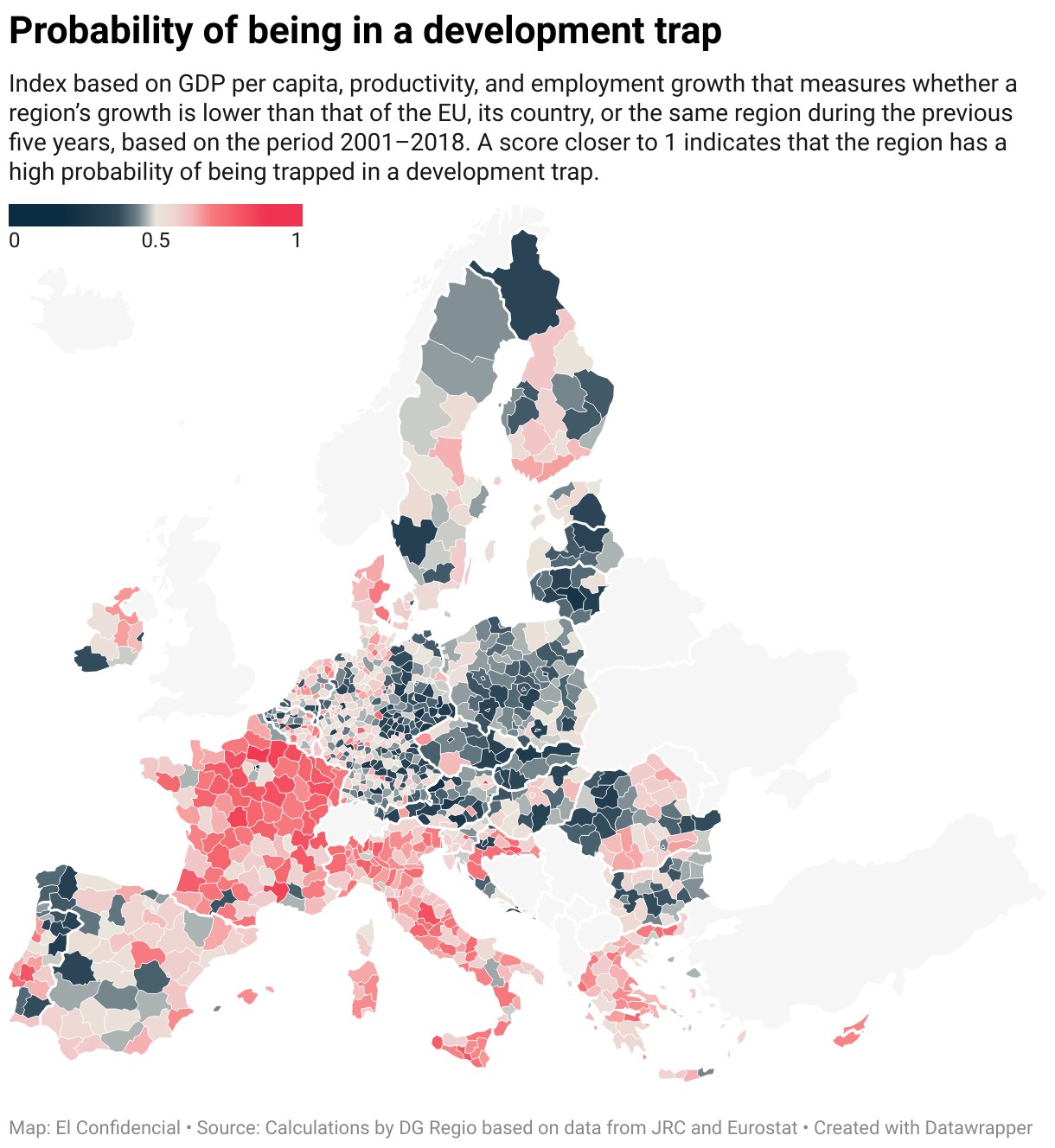
The phenomenon draws a map of internal borders that goes beyond the classic north-south divide. There is no single cause or clear culprit; each region stagnates for different reasons. In some, weak governance weighs heavily; in others, inefficiency in innovation, lack of specialization, skill mismatches, or the deterioration of basic services over time are to blame.
Avoiding these pitfalls requires perseverance, public-private collaboration, and effective co-governance. When institutional quality is low and coordination between administrations fails, European investments lose their impact. The economy weakens and social benefits evaporate.
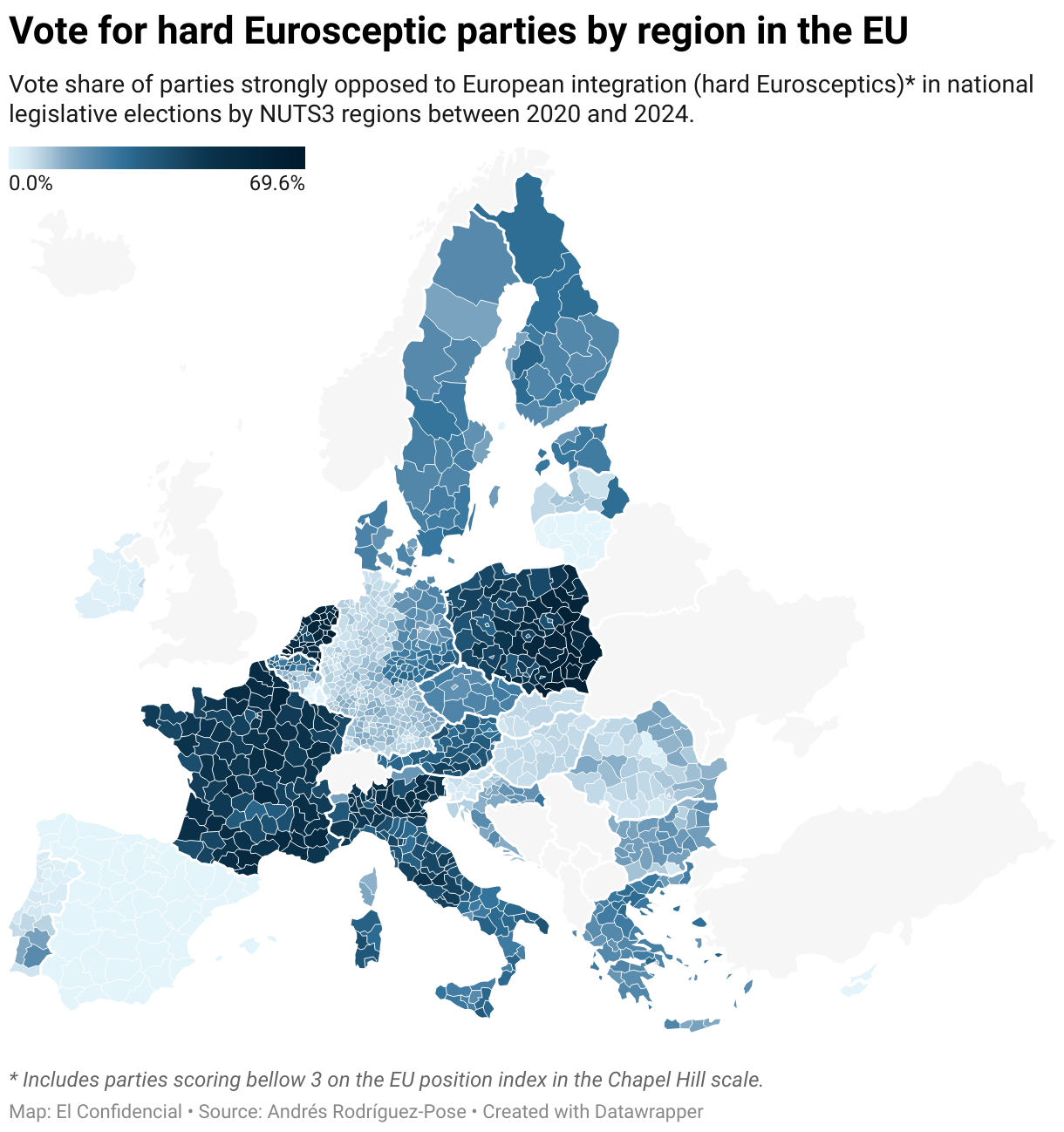
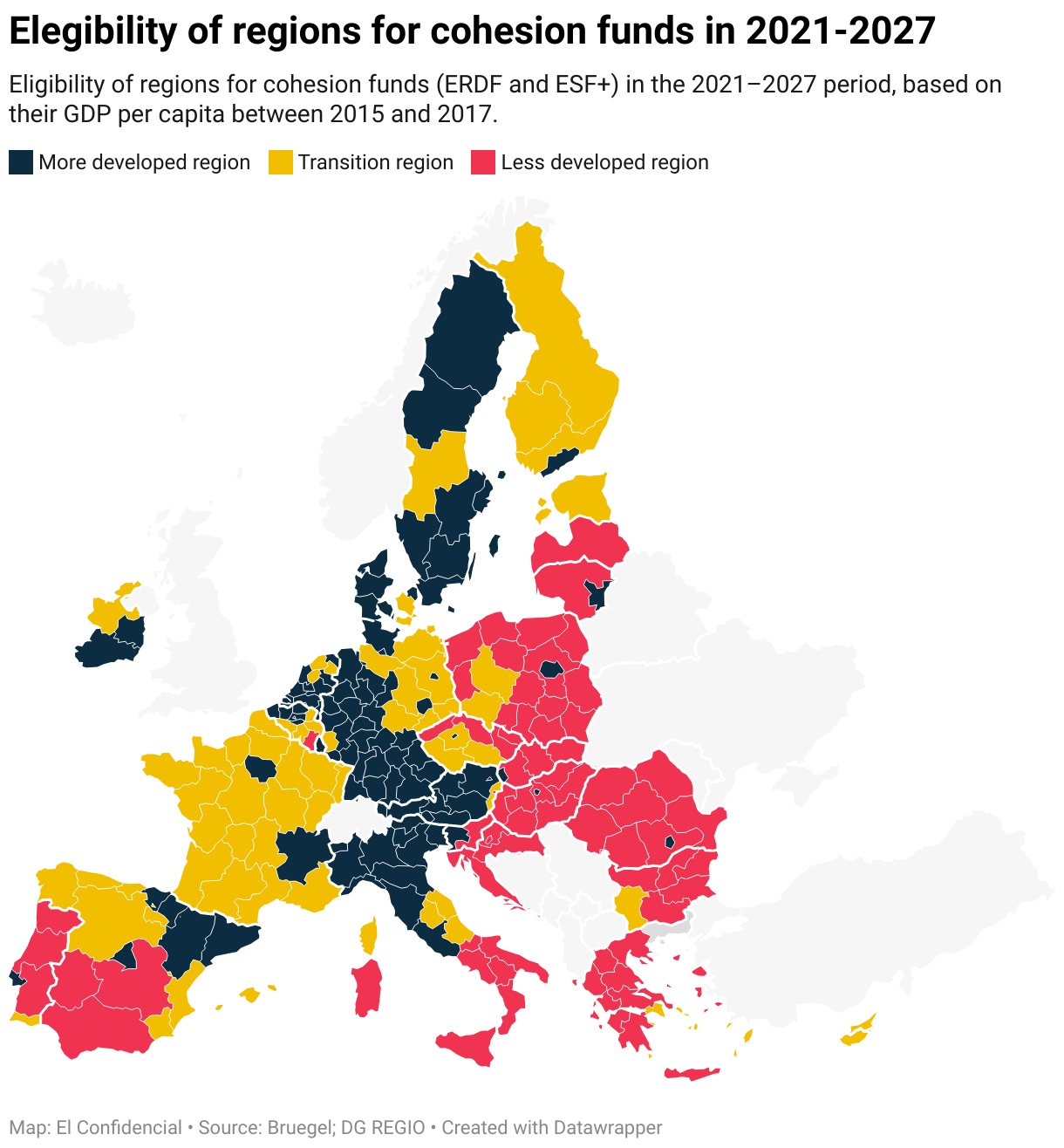
“This gap goes beyond the traditional north-south or east-west divisions, which have lost relevance in many European countries,” adds Rodríguez-Pose. Trapped regions are spread across the European Union. Most of Italy, the Paris area and eastern France, and some regions of Croatia and Greece show pronounced stagnation. Even in very dynamic countries there are trapped regions, such as the Midlands in Ireland.
In Eastern Europe, this phenomenon is reflected in “rural ghettos.” “These are large areas with tens of thousands of inhabitants who are cut off from employment, education, and essential services. In these areas, life expectancy can be up to ten years lower than in the more prosperous parts of the country,” says László Andor, former European Commissioner for Employment and Secretary-General of the European Foundation for Progressive Studies.
The lack of opportunities particularly affects those at risk of poverty or social exclusion. “Vulnerable families are trapped in a cycle of low income, poor housing, and higher relative spending on food and energy, which exacerbates inequalities and limits their opportunities for development,” explains Carlos Susías, president of the European Anti-Poverty Network (EAPN).
Fuel for the extremists
Experts say that falling into a development trap is “possibly the strongest driver behind rising discontent and growing support for Eurosceptic voting in European regions.” Areas that were once prosperous but are now in economic decline, with aging populations and high levels of immigration, show a greater tendency to support Eurosceptic political options.
“The lack of support for lagging regions is driving the growth of right-wing populist parties, which channel economic discontent toward migrants, fueling xenophobia and deepening rejection of the European Union,” says Andor. National policies, far removed from local realities, have distanced voters from traditional parties.
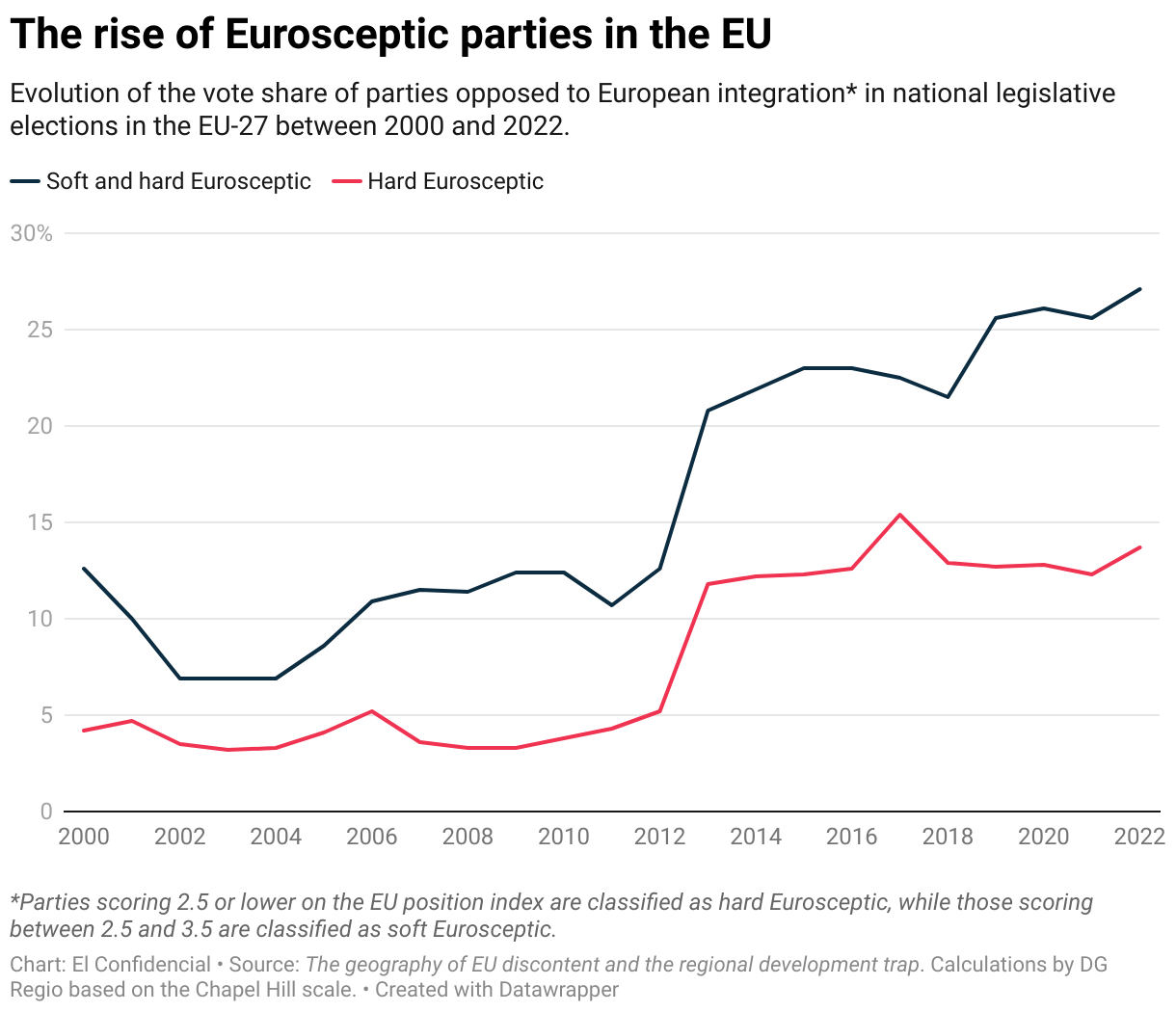
Once a minority, Eurosceptic parties—both hardline and soft—have seen their electoral support skyrocket since the financial crisis. In 2022, they won 27% of the vote. In the European Parliament, the three radical right-wing groups—European Conservatives and Reformists, Patriots for Europe, and Europe of Sovereign Nations—have a total of 187 seats, just one less than the European People’s Party.
The far right governs in three countries—Italy, Hungary, and Finland—and is the leading force in France, the Netherlands and Austria and the second largest in Germany and Portugal. “Governments led by anti-establishment parties rarely produce positive results in the medium or long term. Their management tends to reduce expected economic growth by between 10% and 12%, negatively affecting employment, productivity, innovation, and scientific research,” says Rodríguez-Pose.
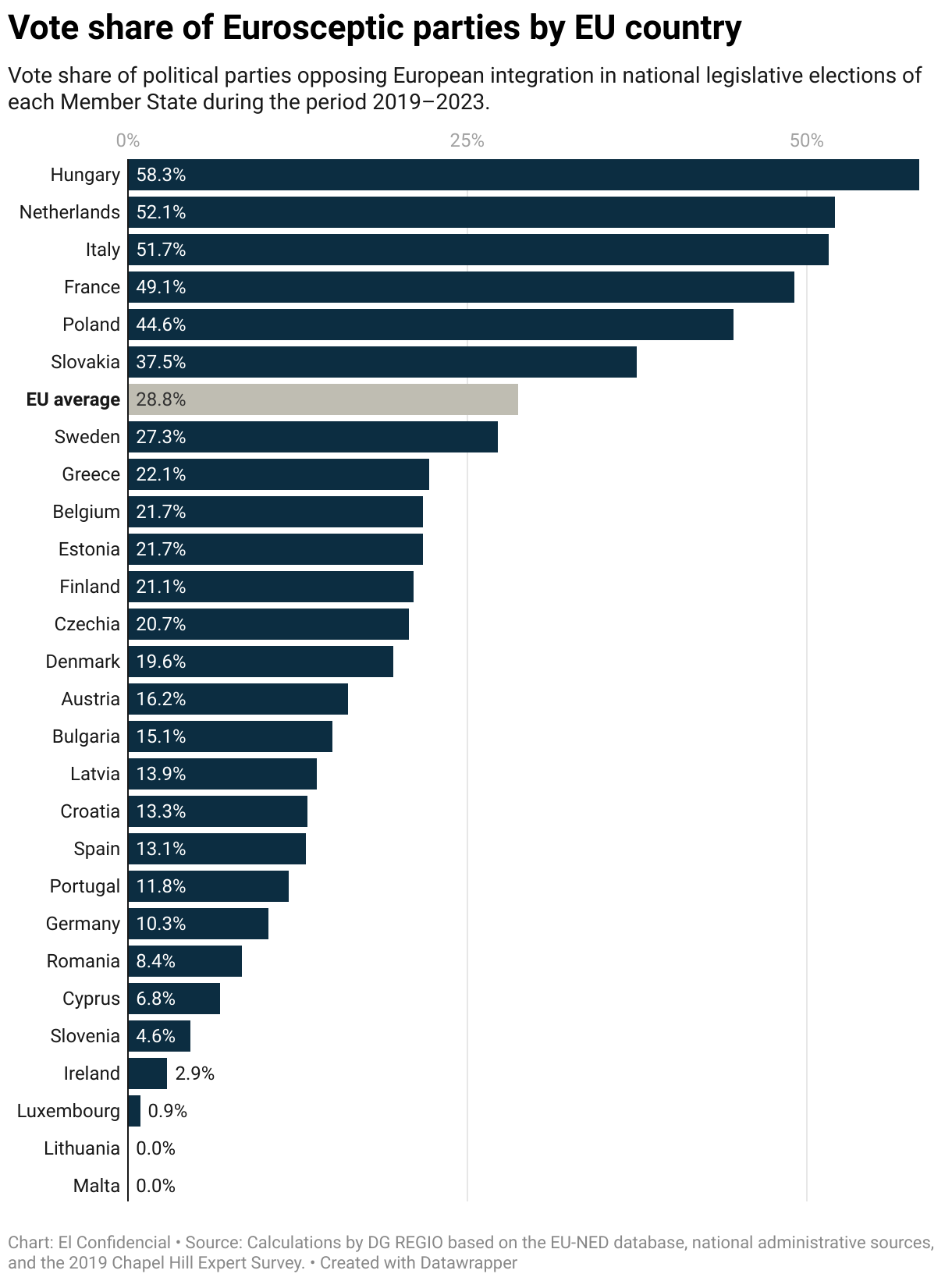
Even without reaching government, their agendas generate strong polarization. “The debate on immigration that exists today could not even have been imagined by extreme parties ten years ago,” he adds.
Support for these parties is higher in less developed and transition regions (34%) than in more developed regions (22%), although the latter opt more for “hardline” Eurosceptics (15% versus 9%).
The European shift in cohesion
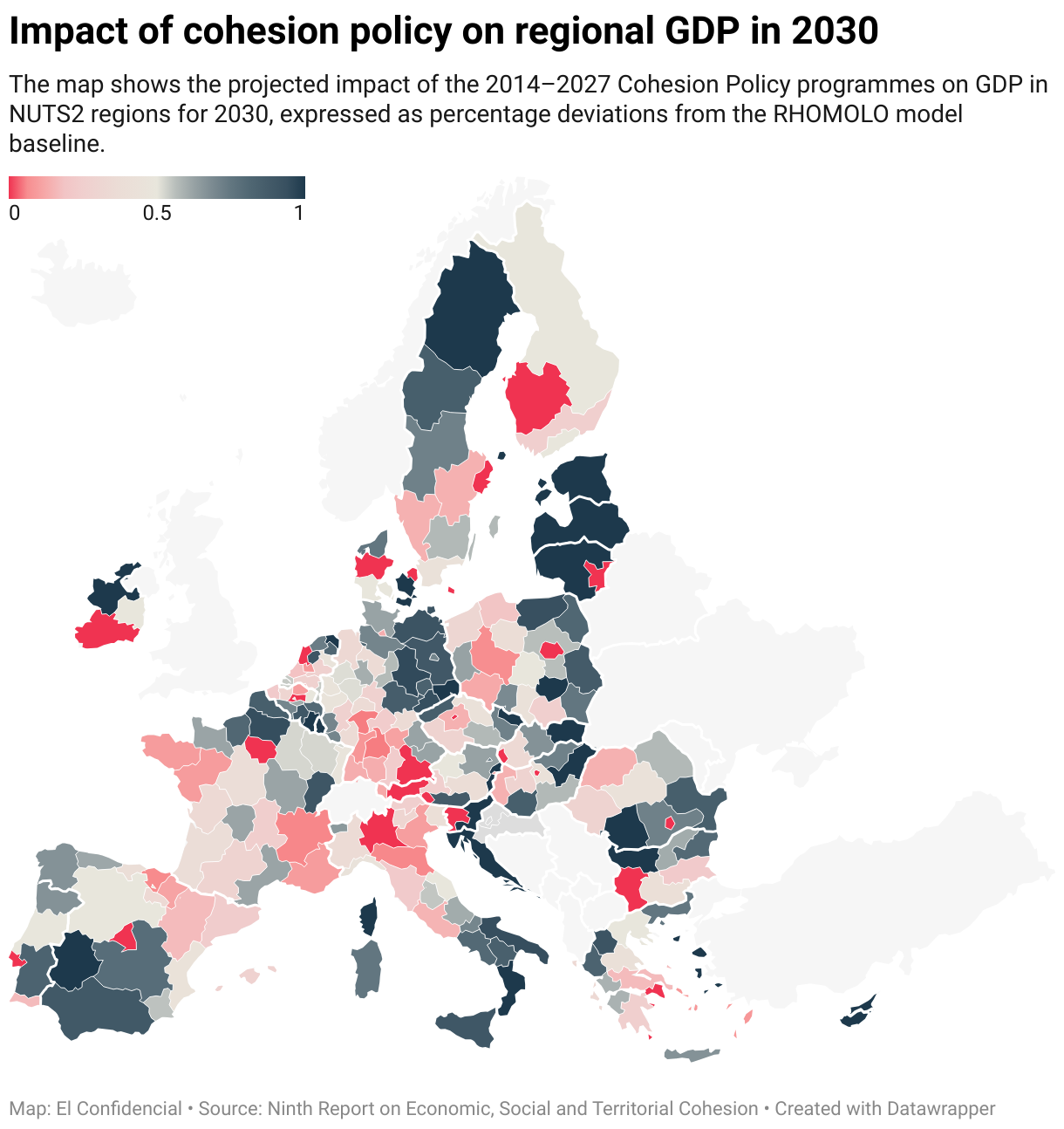
Cohesion policy and regional funds are key tools for counteracting these dynamics. Jacques Delors, president of the European Commission between 1985 and 1995, strengthened them to ensure that peripheral regions contributed to shared growth, consolidating the economic and political integration of the EU.
The European Commission is now preparing a profound shift in the architecture of cohesion policies with the budget for 2028-2034. It plans to merge the Common Agricultural Policy (CAP) and cohesion funds into a single financial block, with 27 national plans replacing regional programs.
In practice, this means nationalizing cohesion policy. The power to decide which projects to finance and how to set priorities will fall to the states, reducing the influence of regions and local actors. “If the Ministry of Finance decides everything, it amounts to a covert constitutional reform” warns Serafín Pazos-Vidal, an expert in rural and territorial development at the think tank European Association for Innovation in Local Development (AEIDL).
In addition, the merger of agricultural and cohesion funds creates competition for financial resources. Long-term structural investments could be displaced by more immediate or politically profitable objectives. “Whoever governs Spain in 2027 will have a historic opportunity: to commit to rural and territorial development or to allocate funds to other priorities,” acknowledges Pazos-Vidal.
This change of course coincides with a period of global transformation, marked by geopolitical fragmentation, wars, the deglobalization of value chains, and the emergence of artificial intelligence. The European Commission is committed to strengthening competitiveness against the United States and China in sectors where it is at a disadvantage, such as semiconductors and AI, rather than strengthening its regional innovation ecosystems.
As a result, less developed territories could be left behind, without receiving the necessary impetus to escape their respective development traps. “This creates a huge political problem. Some will ask: if we don’t take advantage of the potential of the regions, why are we in the Union?” reflects Rodríguez-Pose.
A three-speed Europe
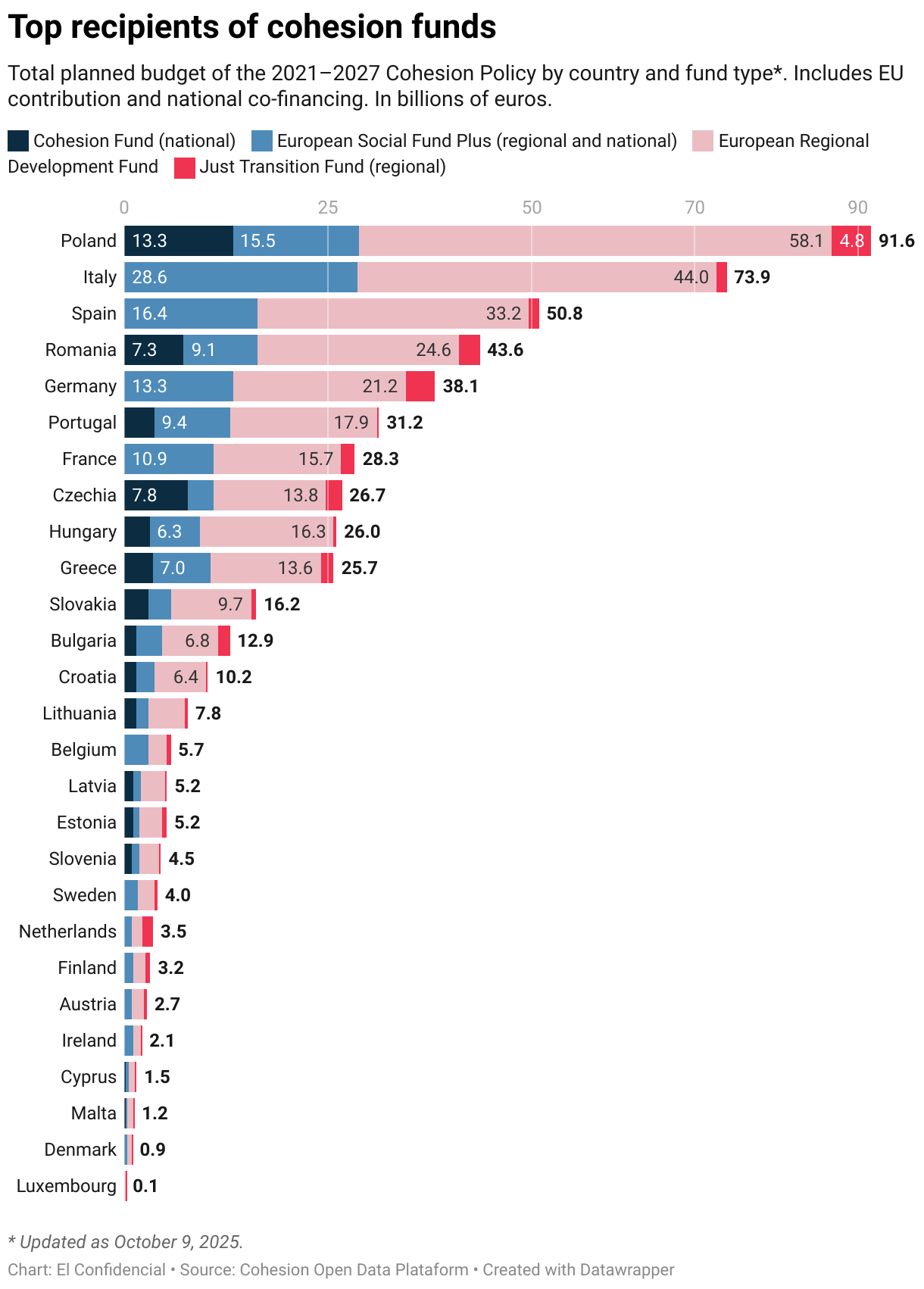
Until now, cohesion policy has had a history of success, albeit uneven depending on the region and the period. The World Bank describes it as the greatest “convergence machine” in the modern world. In five of its seven enlargements, the Union incorporated countries with below-average levels of development, which were integrated thanks to this mechanism. Since the late 1980s, it has invested more than €1 trillion in cohesion, which currently represents a third of the EU budget.
“In Spain and Portugal, these funds were essential for modernizing infrastructure and connecting territories. However, much of the investment focused on physical works rather than key areas for future competitiveness, creating imbalances that still limit their development,” acknowledges Rodríguez-Pose.
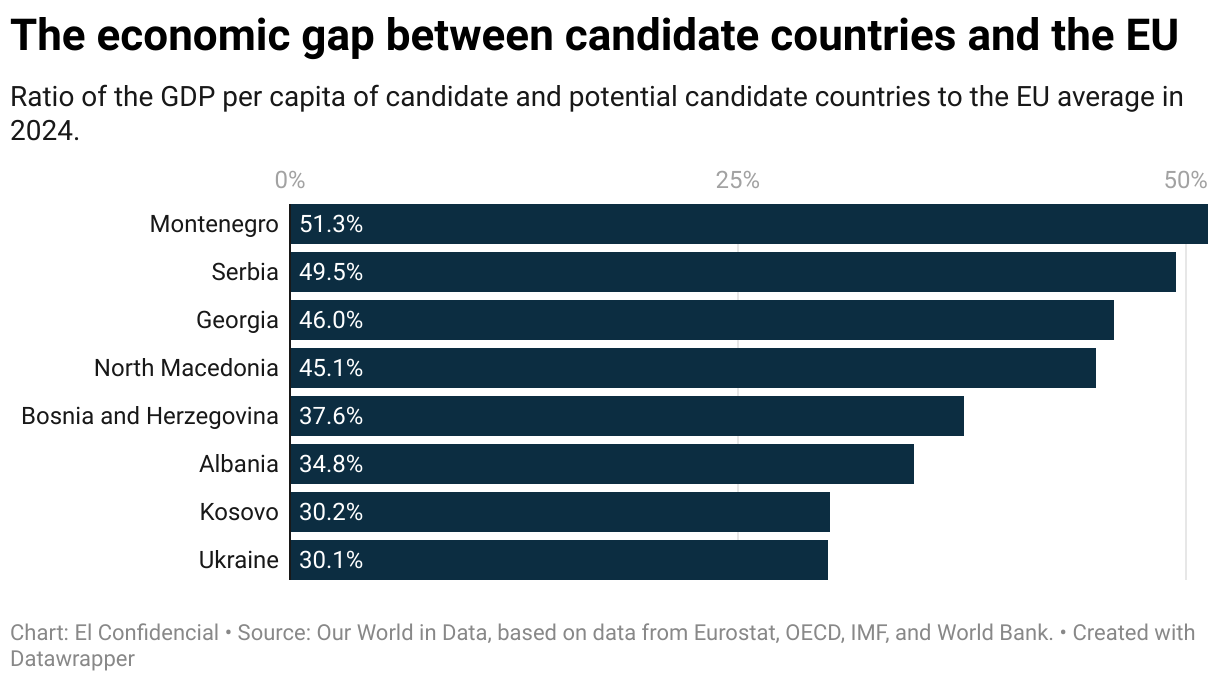
While Eastern European countries are converging rapidly, Southern Europe has remained stagnant since the 2008 crisis. The possible enlargement to 36 members—the Western Balkans, Moldova, Georgia, and Ukraine—would profoundly alter the political, institutional, and financial balance of the EU, forcing it to reform its institutions, decision-making rules, and budgetary framework.
“Ukraine would absorb a very significant part of the aid,” Andor acknowledges. Bruegel estimates that Italy and Spain would lose around €9 billion each, although the overall economic boost could offset this loss.
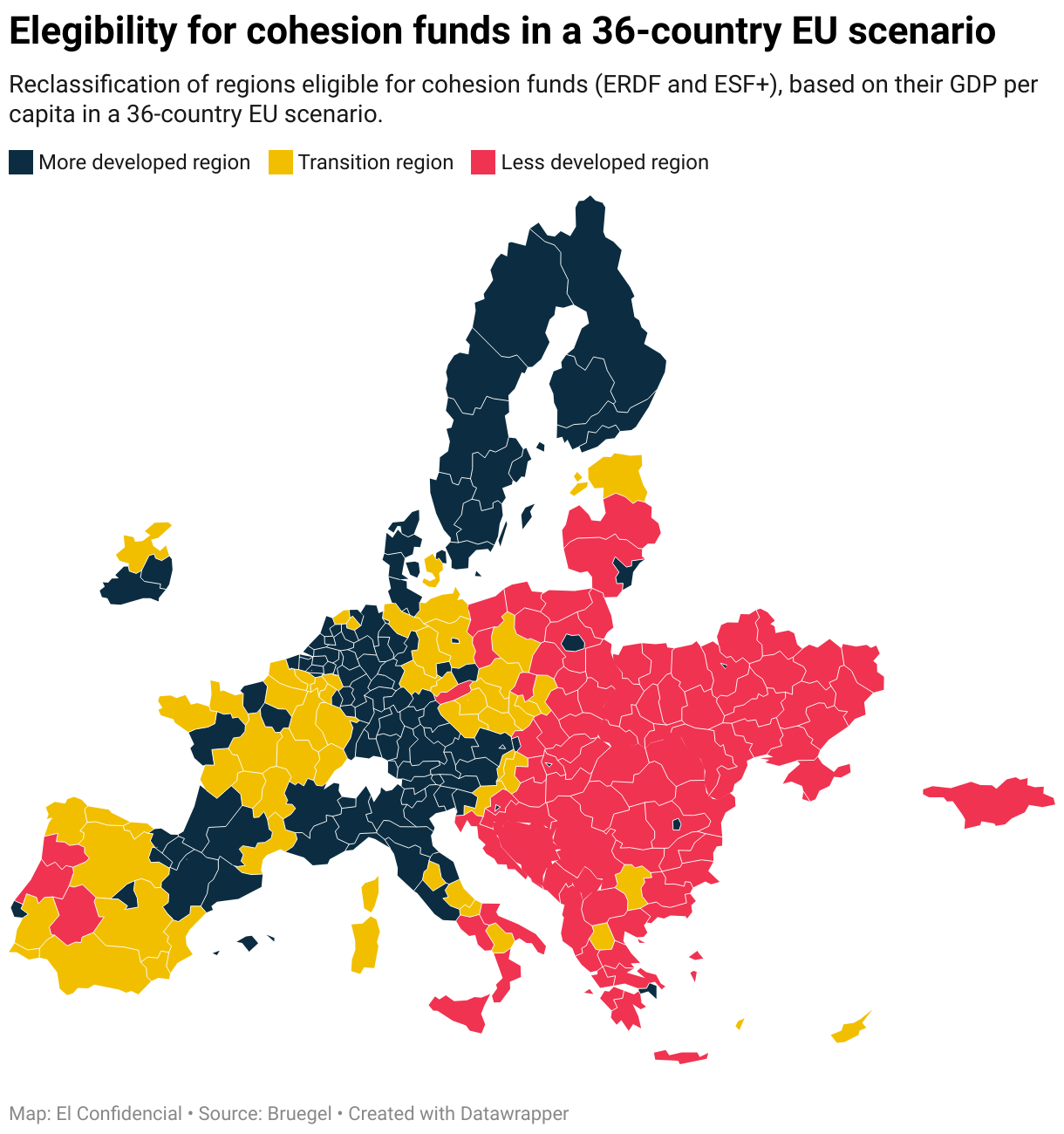
Without strengthening investment in less developed and border regions, the EU could fragment into a “three-speed” space: a competitive north, a dependent south, and an east in reconstruction. This gap threatens economic cohesion and fuels Euroscepticism.
The right to stay
“Our goal is clear: we want prosperous, sustainable, and inclusive regions and cities, so that everyone has the right to stay in the place they call home,” said European Commission President Ursula von der Leyen in November 2024.
In asserting the “right to stay,” Brussels took up one of the central ideas of the Letta report, which places the “freedom to remain” on the same level as freedom of movement as a principle of territorial cohesion in the EU. “The Single Market must empower citizens, not create circumstances that force them to move in order to prosper. Free movement is a valuable asset, but it must be a choice, not a necessity,“ the text states.
The challenge now is to make it a reality. “We seek to make it a principle backed by enforceable rights, investment in economic development, and funding aligned with basic service needs” explains Pazos-Vidal.
There are different approaches: southern Europe focuses on rural depopulation; Eastern Europe prioritizes stemming the brain drain; and the Scandinavian countries apply smart contraction, accompanying the gradual abandonment of certain areas.
The lack of coordination between paradigms limits their effectiveness. “Recognizing this right implies assuming its economic and social cost. It is not enough to lament inequality; active policies must be implemented that allow people to stay with real guarantees of well-being and opportunities,” Pazos-Vidal emphasizes.
Original source: https://www.elconfidencial.com/mundo/europa/2025-10-13/fronteras-internas-alimentan-voto-ultra-europa_4225472/.
